Our Philosophy — Zen Pod

Our Philosophy

A Living
Practice

Zen Pod was never created as a gym, a clinic, or an escape from life. It was created as a space where body, mind, breath and community meet as one continuous, unfolding experience.

Explore
breath
What We Believe

Health is not a
destination.
It is a relationship.

We believe wellness is not something you achieve once and then keep forever. It is something you return to, again and again — a practice, not a prize. A conversation with yourself, not a finish line.

At Zen Pod there is no final mastery. No point where someone becomes "finished." Every breath is new. Every day teaches something different. Every difficulty becomes part of the path itself.

Growth is not linear. Healing is not perfection. And the journey continues for all of us — including those who teach here.

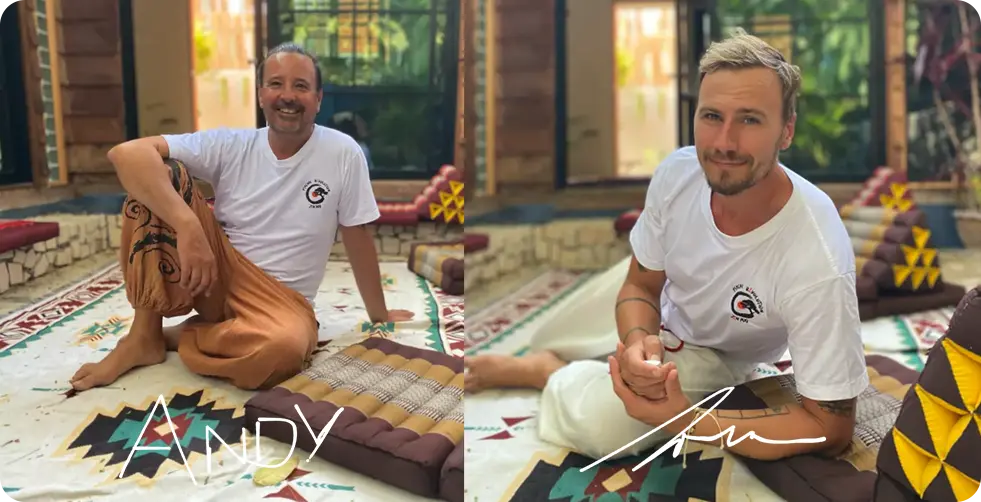
We Walk the Same Path

Teaching, for us, is not standing above others — it is walking beside them. We breathe. We move. We struggle. We learn. What we share is not a method handed down from certainty, but a practice lived through honest daily returning.


Drawn From Many Wells

The Voices That
Shape Us

No single tradition holds the full picture. We draw from many wells — Eastern philosophy, Western thinkers, indigenous earth wisdom, and modern science — finding the living threads that run through all of them.

The Dao Taoist Philosophy · Laozi

The Dao De Jing teaches that true strength is soft, that balance emerges from alignment rather than force, and that water — yielding and endlessly persistent — is the most powerful element in nature. We carry this not as doctrine but as a felt orientation: listen to the body, allow change, move with life rather than against it. The river does not fight its banks. It simply flows.

"The Dao that can be named is not the eternal Dao. What we are pointing toward cannot be captured in a system — only lived."
Alan Watts Philosopher · Bridge Builder

Watts was one of the great bridge builders between East and West — bringing Zen, Vedanta and Taoism into conversation with modern Western life with wit, warmth and radical honesty. He dismantled the wall between the sacred and the ordinary, reminded us that this moment is already whole, and that the self we're frantically trying to improve may itself be the only problem. His playfulness is part of our practice.

"The more a thing tends to be permanent, the more it tends to be lifeless."
Krishnamurti Philosopher · Radical Inquiry

Krishnamurti refused all gurus, all systems, all inherited answers. He returned again and again to the same fierce invitation: look at what actually is, without the filter of what you've been told. Don't follow a path — observe. Don't seek authority — question. His challenge runs through everything we do. Not to give people a method, but to support them in truly seeing themselves.

"The ability to observe without evaluating is the highest form of intelligence."
🌿 Shamanic Wisdom Indigenous Traditions · Earth & Ceremony

Across cultures and centuries, shamanic traditions share a core understanding: the human being is not separate from the living world. Healing is relational — between self and community, between the individual and the earth, between the waking mind and the deeper intelligence the breath can access. Every session carries something of this quality. The body knows things the thinking mind does not.

"The wound is the place where the light enters you." — Rumi
Zen Buddhist Practice · Beginner's Mind

Zen does not ask you to believe anything — only to look, to sit, to breathe, and to return. Shoshin, the beginner's mind, is our most practised principle: open, curious, free from the fixed conclusions that prevent genuine encounter. The expert is finished. The beginner always has more to discover. We try to enter every room, every breath, every conversation as if for the first time.

"In the beginner's mind there are many possibilities. In the expert's mind there are few." — Shunryu Suzuki
Modern Science Neuroscience · Somatics · Research

Ancient practices are now meeting modern rigour. Breathwork, movement and stillness have measurable, peer-reviewed effects on the nervous system, hormones, sleep and emotional regulation. We honour the depth of traditional wisdom while embracing what science continues to illuminate about the body as a living, adaptive system. Both are true. Both are necessary.

"The body keeps the score." — Bessel van der Kolk

Four Dimensions

Body, Mind, Soul
& Community

Human wellbeing cannot be separated into isolated parts. The body influences the mind. The mind affects the nervous system. The nervous system shapes emotion. And all of it deepens through community and honest shared practice.

Body

Not a machine to be fixed. A living intelligence to be listened to, moved with, and cared for through breath and patient attention.

Mind

Through breathwork and stillness, we learn to observe thought without being swept away by it. Awareness is not suppression — it is space.

Soul

Beneath thought, beyond the physical — there is something quieter. We create room for that dimension to be heard without being named.

Community

We are wired for each other. Healing accelerates in the presence of others who are also willing to be honest and present. This is a practice too.


How It Shapes Our Work

The Threads That
Run Through
Everything

These voices don't give us answers. They give us better questions — and a quality of attention that changes how we enter any room, any breath, any conversation with ourselves or each other.

We are not a school. We are not a religion. We do not ask you to adopt a lineage or subscribe to a tradition. We ask only that you arrive with openness — and remain curious about what you find.

🌊

Flow, Not Force

From the Taoist water metaphor: instead of fighting the body, we listen. Instead of forcing transformation, we allow it. Instead of controlling life, we practice moving with it — breath by breath, moment by moment.

🔥

The Sacred Ordinary

From shamanic traditions and Alan Watts alike: the sacred is not elsewhere. Every breath is a ceremony. Every exhale, a small release. Healing is not achieved in dramatic moments — it is accumulated in ordinary ones.

👁

See Without Judging

Inspired by Krishnamurti: to observe experience directly — without the overlay of judgment, comparison, or borrowed interpretation. This quality of bare attention is the foundation of all breathwork and all honest movement.

The fire does not ask permission to burn.

The river does not ask where to flow.

Nature knows what it is doing.

So do you — when you are still enough to listen.


Zen Principle

Always the
Beginner

The beginner's mind — shoshin in Zen — is open, curious, and free from the weight of accumulated conclusions. The expert believes they already know. The beginner remains genuinely available to discovery.

Krishnamurti called it looking with fresh eyes. Watts called it learning to live fully in the present without the map of yesterday. Whatever you call it — this quality of humble attention is at the centre of what we do.

Each session at Zen Pod is an exploration, not a performance. Not a test to pass, but a moment to inhabit fully — without needing it to be anything other than what it is.

Not Knowing Is the Door

Zen Pod is not about gurus or perfection. It is about presence, consistency, and honest exploration. To say "I don't know" and remain curious — that is not weakness. That is the beginning of everything real.


The Ongoing Path

Returning to What
Is Already Within

We do not believe we are giving people something they lack. Rather, we help people remember something they already carry — the ability to breathe deeply, move freely, feel fully, and live with awareness.

Zen Pod is simply a space that supports that remembering. A clearing in the forest. A still pool that reflects what is already there, once the surface calms enough to see clearly.

The practice begins where you are. In this body. In this breath. At this moment. Not when you are ready. Not when you are healed. Now, as you are — because the journey is always unfolding and it has no final destination.

We Walk With You

We breathe. We move. We struggle. We learn. And we do all of it alongside the people who come through these doors — because healing has always happened together, in the company of those willing to be honest with themselves.